


Is it iron deficiency or perimenopause?
Fatigue. Brain fog. Low mood. Poor sleep. Heavier periods. Less energy. Feeling less like yourself.
These are often talked about as perimenopause symptoms. And sometimes, that is exactly what they are. But one of the key messages Dr Libby has long shared is that symptoms are not labels – they are signals. And while hormonal shifts during perimenopause are very real, they are not always thedriver of how a woman feels.
Sometimes, what looks like perimenopause may be iron deficiency. Sometimes, it is both.
Why this matters
In recent years, perimenopause has become part of the public conversation. This is important because women deserve to understand what is happening in their bodies during this transition. But there is another side to this awareness. Perimenopause can become the explanation for everything.
Tired? Perimenopause.
Foggy? Perimenopause.
Flat mood? Perimenopause.
Poor sleep? Perimenopause.
Heavier periods? Perimenopause.
Hormones may absolutely be involved in driving symptoms, but they may not be the whole story or even the story at all. If they were the whole stiry even woman would suffer across the perimenopause transition and this is not the case. Dr Libby’s perspective is that we need to look at the whole body, not just the hormone headline. A woman’s nutritional status, stress load, liver function and bile production, thyroid health, blood sugar regulation and insulin response, digestion and life history all influence how she experiences this transition. And iron deserves particular attention.
The symptom overlap is significant
A 2025 review explored this exact issue. The paper, titled Addressing the perimenopause: what’s blood got to do with it?, discussed the clinical overlap between perimenopause symptoms, heavy menstrual bleeding and iron deficiency anaemia. The authors highlighted that perimenopause can involve symptoms such as irregular or heavy menstrual cycles, brain fog, impaired cognition, hot flashes, mood changes, insomnia, fatigue, low libido and vaginal dryness.
They also discussed how symptoms of iron deficiency overlap with perimenopause, including increased fatigue, reduced exercise tolerance, shortness of breath, poor concentration, reduced cognitive function, headaches, depressed mood and anxiety. This is why it can be so difficult to know what is really driving how you feel.
If a woman is exhausted, foggy, anxious, sleeping poorly and having heavier periods, it may be tempting to say, “This is perimenopause.” But what if heavier periods are both the cause and consequence of iron deficiency, and their ongoing nature is quietly depleting her iron stores? What if her low iron is the cause of the fatigue, brain fog and emotional fragility or making it feel far worse than it would be if she was iron replete? What if the label of perimenopause is leading you to miss what is really driving your symptoms? Or what if perimenopause is part of your picture, but not the only thing asking for attention?
Perimenopause can change your iron needs
During perimenopause, menstrual cycles can become less predictable. For some women, periods become lighter or further apart. For others, they become heavier, longer or more frequent. This matters because heavier bleeding increases iron loss. A woman may enter this life stage already iron depleted from years of menstruation, pregnancies, breastfeeding, under-eating, plant-based eating, gut issues, inflammation, chronic infections or previous low iron. Then perimenopause arrives, periods become heavier and her iron stores are asked to stretch even further.
This is one reason Dr Libby encourages women to know their iron status rather than guessing. Because if iron is part of the picture, it is measurable. And once it is identified, it can be addressed.
Low iron is often tolerated, not corrected
Many women know their iron is “a bit low”. They may have been told this for years. Some have tried iron supplements but stopped because the ones they tried caused constipation, nausea or digestive discomfort. Others have been told their haemoglobin is normal, without understanding whether their ferritin stores are robust.
This is where the conversation can become too narrow. Iron deficiency is not only about anaemia. Haemoglobin tells us about the oxygen-carrying capacity of your red blood cells. Ferritin gives us a clearer picture of stored iron – think of this like your back-up battery – which is the best way we currently have to assess your bone marrow iron status. You can have normal haemoglobin while your iron stores are still low. And when ferritin is low, the body may have very little in reserve.
That reserve matters. Iron is involved in oxygen transport, cellular energy, thyroid hormone production and activation, immune function, cognition and the production of neurotransmitters such as dopamine, serotonin and GABA. So when iron is low, it is not just energy that can be affected. Mood, motivation, mental clarity, sleep quality, exercise tolerance and resilience can all feel compromised .
Why iron is a powerful place to start
If you are in your late 30s, 40s or early 50s and you feel unlike yourself, it can be hard to know where to begin.
Is it perimenopause?
Is it iron deficiency?
Is it thyroid?
Is it stress?
Is it blood sugar?
Is it all of the above?
The reason iron is such a helpful starting point is that it can be tested – and it’s so incredibly common. It gives you information you can act on. Dr Libby encourages women to test iron studies, not just haemoglobin. This includes ferritin, serum iron, transferrin saturation, transferrin or total iron-binding capacity, plus markers such as CRP can be helpful because inflammation can affect how ferritin is interpreted.
This is not about self-diagnosing or assuming iron is always the answer. It is about addressing one of the most common and overlooked drains on the system. When low iron is part of the picture and it is corrected, many women notice they feel more like themselves again. Energy feels steadier. Brain fog lifts. Exercise feels less punishing. Mood is less fragile. Sleep feels more restorative.
This might not mean every perimenopause symptom disappears (for some, they do!). Hormonal changes may still need support – or not. But if iron deficiency is contributing to the load, addressing it can change the whole terrain. It’s why Dr Libby titled her book “Fix Iron First: the one thing that changes everything”.
What could help?
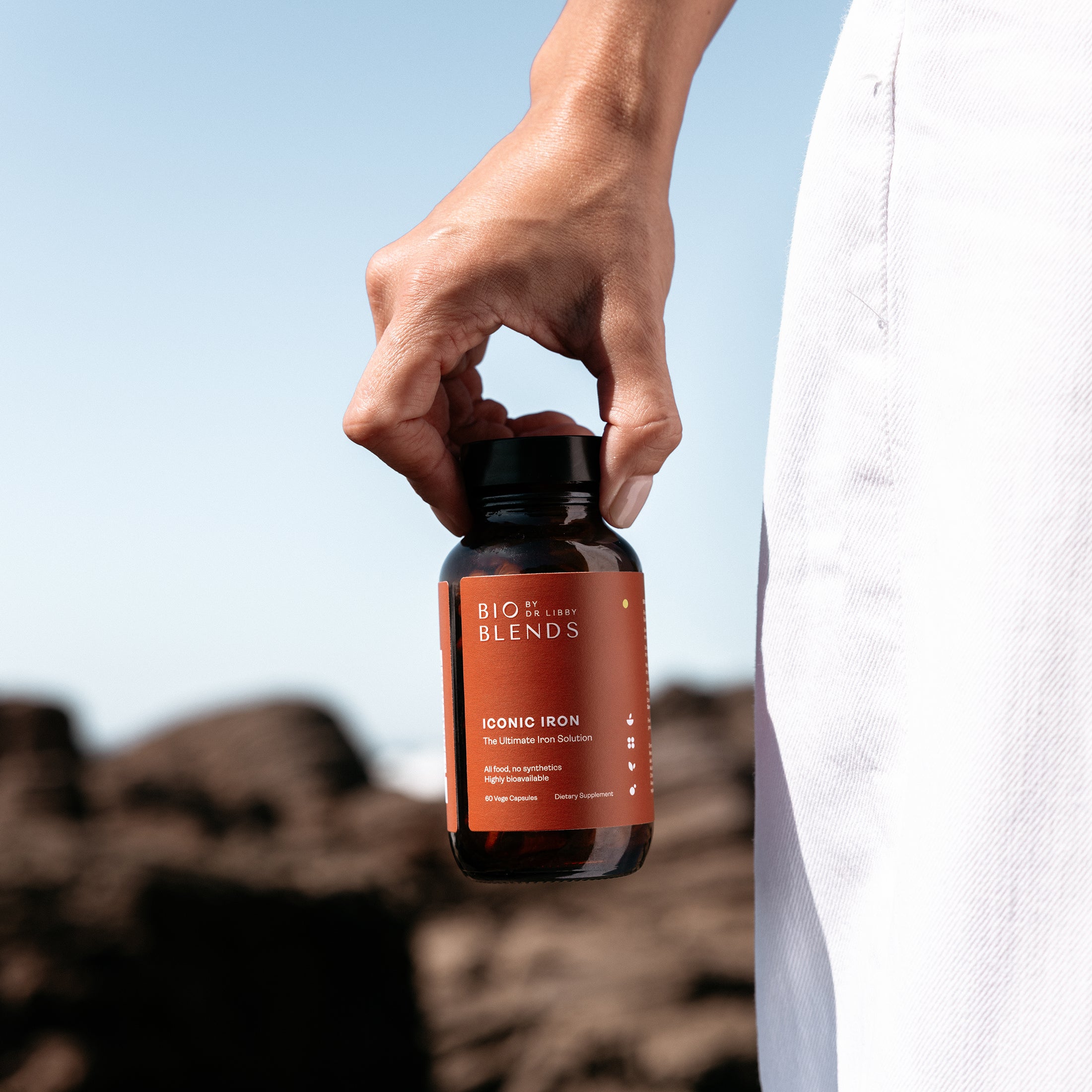
Iconic Iron™ was formulated by Dr Libby for people who need iron support, even more so if you’ve struggled with traditional forms. It contains food-origin ferritiniron from organic peas. Ferritin is the structure in which plants and animals naturally store iron. This food-origin form of iron that has its own unique absorption mechanism, different from both haem and non-haem iron, was chosen to support iron intake in a way that is gentle, absorbable and recognisable to the body. Rather than flooding the system with high-dose iron salts, Iconic Iron™ offers daily support designed to work with the body. And with iron, consistency matters.
For those who need additional hormonal support, Cycle Essentials has been formulated with key nutrients involved in healthy progesterone production, alongside herbs traditionally used to support adrenal function and hormonal balance. And because the liver plays such an important role in hormone metabolism, Liver Love may also be a helpful part of the picture. It supports the liver’s natural detoxification pathways with food and high quality herbs, helping the body process and eliminate what it no longer needs.
Together, these formulas offer support for some of the key foundations that can influence how a woman feels through perimenopause: iron reserves, hormonal rhythm and liver function.
Please note, Cycle Essentials is suitable if you are still menstruating, while Meno Ease is suited to those who have stopped menstruating.
So, is it iron deficiency or perimenopause?
It may be perimenopause. It may be iron deficiency. It may be both. The important thing is not to assume. Perimenopause is a transition , but it should not become a reason to dismiss symptoms that may have another driver. If you feel tired, foggy, flat, anxious, heavy or unlike yourself, start by listening to the signals. Notice your periods. Notice your energy. Notice whether you are breathless on exertion, unusually cold, shedding hair, craving ice, waking unrefreshed or feeling less resilient than usual. Then consider testing your iron status with your health practitioner.
---

Support through the perimenopause shift.
Iconic Iron™ for energy and iron reserves
Cycle Essentials for hormonal health
Liver Love for liver and hormone metabolism support